
Why Fiber Is Essential for Hormone Balance, Detox & Metabolism (Not Just Digestion)


Let’s talk about fiber! I know, I know—fiber isn’t exactly sexy. It doesn’t have the glamorous appeal of collagen or the trendy mystique of adaptogens. When most people think about fiber, they think about their mom’s bran muffins and regular bowel movements.
And sure, fiber does help you poop. But if that’s all you think fiber does, you’re missing about 90% of the story.
Fiber is one of the most underrated, multitasking powerhouses in your entire body. It’s not just about digestion—it’s about detoxification, hormone balance, blood sugar regulation, and yes, metabolism too.
Let's start by breaking down why fiber deserves way more credit than it gets.
What Actually IS Fiber?
Fiber is the part of plant foods that your body can’t digest. It passes through your stomach and small intestine relatively intact and makes its way to your colon, where the real magic happens.
There are two main types:
Soluble fiber - dissolves in water and forms a gel-like substance.
Think: oats, beans, apples, flaxseed. This is the fiber that helps regulate blood sugar and cholesterol.
Insoluble fiber - doesn’t dissolve in water.
Think: vegetables, psyllium husk, chia seeds. This is the fiber that adds bulk to your stool and keeps things moving through your digestive tract.
You need both. And most people aren’t getting nearly enough of either.
The Fiber-Detox Connection (AKA: How Your Body Takes Out the Trash)
Here’s something most people don’t realize: fiber is your body’s primary garbage disposal system.
Your liver works around the clock to filter toxins, excess hormones, cholesterol, and metabolic waste from your blood. But it can’t just evaporate these things into thin air. It has to package them up and send them OUT of your body.

And how does it do that? ➡️ Through a fantastic substance called **bile**!
Your liver dumps all this waste into bile, which is stored in your gallbladder and then gets released from into your digestive tract after you eat. And this is where fiber is key.
Fiber binds to all that bile-packaged waste (toxins, used-up estrogen, cholesterol, heavy metals, etc.) and escorts it out of your body through your stool.
No fiber = no escort service.
What happens if you don't have enough fiber? Well... your body starts reabsorbing all that crap. Literally. The toxins and excess hormones that were supposed to exit stage left end up getting recycled back into your bloodstream.
This is called **enterohepatic recirculation**, and it’s a major problem.
So when you’re constipated or not eating enough fiber, you’re essentially re-toxifying yourself with waste that your body already worked hard to eliminate. Fun times, right?
The Fiber-Hormone Connection (Especially Estrogen)
Let’s talk about estrogen, because this is where things get really interesting.
Your body is constantly producing and breaking down estrogen. When estrogen has done its job, your liver metabolizes it and packages it up in bile to be eliminated. But if you don’t have enough fiber to bind to that used estrogen and carry it out, guess what happens?
It gets reabsorbed.
This is one of the major contributors to estrogen dominance—that lovely condition where you’re dealing with heavy periods, breast tenderness, mood swings, weight gain (especially around the hips and thighs), and stubborn PMS.
You might not even be producing too much estrogen. You might just be recycling it over and over because you’re not pooping it out effectively.
Fiber can help fix this. It binds to that used-up estrogen and makes sure it actually leaves your body.
But keep in mind that it’s not just estrogen—this applies to other hormones too. Proper elimination is crucial for hormonal balance across the board.
The Fiber-Blood Sugar Connection
Here’s where soluble fiber really shines.
When you eat carbohydrates without fiber, your blood sugar spikes quickly. Your pancreas freaks out and dumps a bunch of insulin to bring it back down. Then your blood sugar crashes, you get hangry, you crave more carbs, and the whole cycle repeats.
But when you eat carbs *with* fiber, the fiber slows down the absorption of glucose into your bloodstream.
This means:
- Your blood sugar rises gradually instead of spiking
- Your insulin response is more measured and controlled
- You stay fuller longer
- You don’t get the crash-and-crave cycle
Stable blood sugar = stable energy, stable mood, stable metabolism.
This is why eating an apple with the skin (fiber intact) is completely different metabolically than drinking apple juice (fiber removed). Same sugar content, totally different effect on your body.
The Fiber-Gut Microbiome Connection
Your gut bacteria LOVE fiber. In fact, certain types of fiber are their primary food source.
When your beneficial gut bacteria ferment fiber in your colon, they produce short-chain fatty acids (SCFAs) like butyrate, acetate, and propionate. These SCFAs are absolute gold for your body:
Butyrate is the preferred fuel source for your colon cells and helps maintain the integrity of your gut lining (hello, preventing leaky gut).
Acetate and propionate help regulate appetite, reduce inflammation, and improve insulin sensitivity. And get this... These molecules help with the production of GLP-1, a hormone that regulates appetite so that you don't over-eat. (Yep - the same hormone that people are paying big bucks for the synthetic agonist versions of like Ozempic & Semi-glutide).
So fiber isn’t just passing through—it’s *feeding* the beneficial bacteria that keep your entire gut ecosystem healthy.
A healthy gut microbiome influences everything:
immune system
mood
inflammation levels
appetite
metabolism & weight
hormone balance
Everything!
No fiber = starving your beneficial bacteria = dysbiosis = a cascade of problems.
How This All Connects to Your Metabolism
Okay, so here’s where it all comes together.
Your metabolism isn’t just about how many calories you burn. It’s about how efficiently your body processes energy, eliminates waste, and maintains hormonal balance.
When you’re eating enough fiber:
- Your blood sugar is stable, so your insulin sensitivity improves
- Your gut bacteria are thriving and producing SCFAs that improve metabolic function
- Your hormones are balanced because you’re eliminating excess estrogen & other used hormones
- Your body is detoxifying efficiently instead of recycling toxins
- Your thyroid can function optimally (because your gut health and blood sugar directly impact thyroid function)
- Your inflammation levels are lower
All of these factors directly impact your metabolic rate and your body’s ability to maintain a healthy weight.
Think of fiber as the foundation that everything else is built on. You can’t have optimal metabolism without proper elimination. You can’t have hormone balance without detoxification. You can’t have stable energy without blood sugar regulation. And fiber is central to ALL of it.
Think of it like this: if your metabolism is a house, fiber is the plumbing. You can have beautiful countertops and fancy appliances (supplements, workouts, etc.), but if the plumbing doesn’t work, you’ve got a serious problem.
How Much Fiber Do You Actually Need?
The general recommendation is 25-35 grams per day, but honestly, many people do better with even more—especially if you’re dealing with hormone issues, constipation, or blood sugar dysregulation.
But here’s the thing: you need to increase fiber gradually. If you go from 10 grams a day to 40 grams overnight, you’re going to be bloated, gassy, and miserable. Your gut bacteria need time to adjust.
Start where you are, add 5 grams every few days, and work your way up. And make sure you’re drinking plenty of water—fiber needs water to do its job.
The Best Sources of Fiber
High-fiber vegetables;
Broccoli, Brussels sprouts, cauliflower
Artichokes (a fiber powerhouse)
Leafy greens
Carrots, beets, sweet potatoes
Fruits:
Berries (especially raspberries and blackberries)
Apples and pears (with the skin)
Avocados (yes, they’re high in fiber!)
Legumes:
Lentils
Beans
Split peas
Nuts and seeds:
Chia seeds, flaxseeds, hemp seeds
Almonds, walnuts
Whole grains (if you tolerate them):
Oats, quinoa
Buckwheat, wild rice
Resistant starch:
Limit to 1/2 cup per serving to avoid spiking blood sugar
Cooked and cooled potatoes or rice
Green bananas or plantains
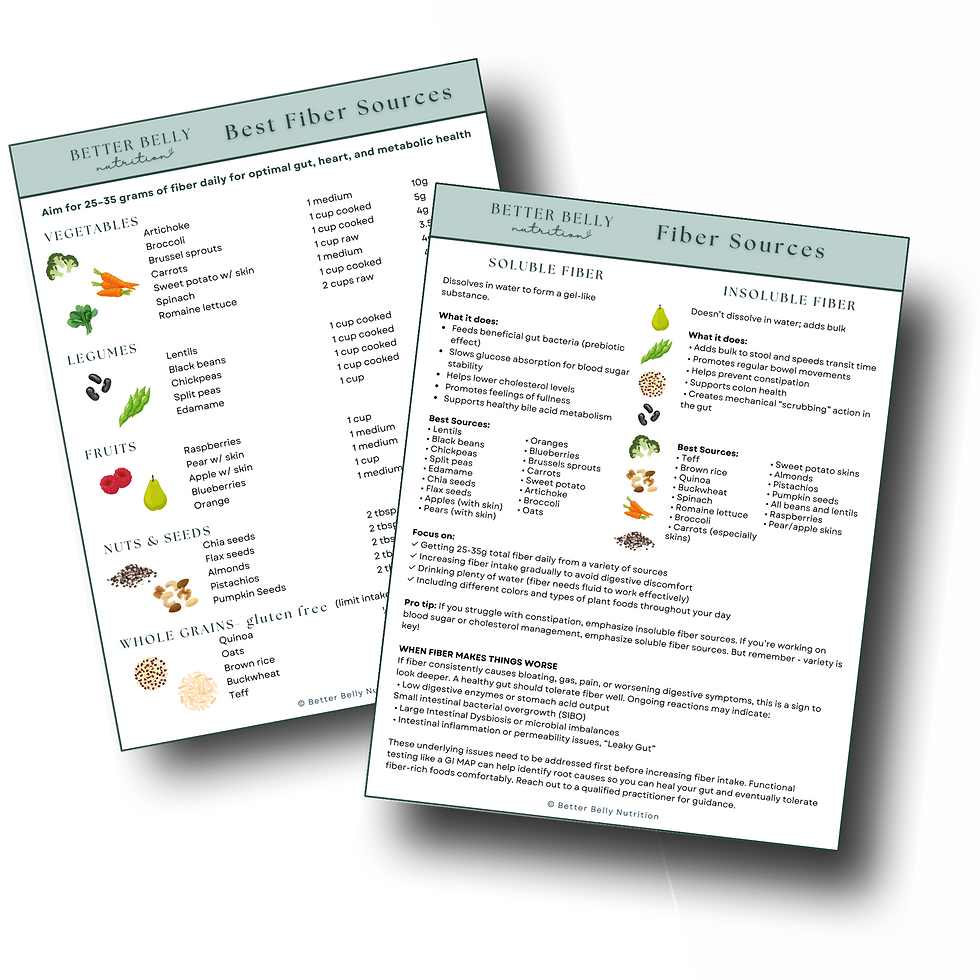
And if you need extra support, there are quality fiber supplements like acacia fiber, partially hydrolyzed guar gum (PHGG), or psyllium husk—but whole food sources are always preferable.
Click below to download my handy Fiber Made Simple Guide:
What If You’re Already Eating Fiber But Still Constipated?
This is a common issue, and it usually means one (or more) of these things is happening:
You’re not drinking enough water.
Fiber without water is like trying to slide down a dry slip-n-slide. Not fun.
Be sure to remineralize your water with electrolytes so that your cells can actually absorb the hydration.

Your digestive system needs additional support.
You might need digestive enzymes, supplemental stomach acid, bile support, or magnesium to help things move. CLICK HERE for my favorite digestive supports.
You have an underlying gut issue.
SIBO, dysbiosis, or motility problems can all interfere with proper elimination, even with adequate fiber intake.
Your nervous system is stuck in “fight or flight.”
Stress literally shuts down digestive motility. You can’t “rest and digest” if you’re constantly in sympathetic overdrive.
If you’re doing everything right with fiber and still struggling, it’s time to dig deeper with functional testing.
Fiber is not just about pooping (though let’s be real, that’s important).
It’s about:
- Detoxification (eliminating what your body worked hard to filter out)
- Hormone balance (especially estrogen)
- Blood sugar regulation (stable energy and metabolism)
- Gut microbiome health (the foundation of everything)
- Metabolic function (all of the above working together)
When you support these foundational processes with adequate fiber, you create a ripple effect of better health across every system in your body.
So yeah, maybe fiber isn’t as sexy as the latest supplement trend. But it’s one of the most powerful, evidence-based, accessible tools you have for supporting your metabolism, hormones, and overall health.
Ready to Actually Fix Your Gut?
If you've made it this far, you're probably realizing that fiber is just one piece of the puzzle.
Maybe you're dealing with bloating that won't quit, hormonal issues, stubborn weight, energy crashes, or digestive problems that seem impossible to solve.

Here's the truth: you can't supplement or restrict your way out of gut dysfunction without understanding what's actually broken.
That's why I created the Ultimate Gut Reset—a comprehensive program that teaches you how to support the foundational systems (digestion, detox, blood sugar, hormones, metabolism) that determine whether your gut can actually heal.
This isn't another elimination diet or quick cleanse. It's education, protocols, and practical tools to fix your gut at the root level.
Need help figuring out why your digestion isn’t working optimally despite eating fiber?
That’s exactly what functional testing is for. My personalized nutrition protocols use comprehensive stool analysis, hormone testing, and metabolic panels to identify the root cause—not just throw solutions at symptoms.
Click below to learn more about my services:


Comments